| Overview | All Modules | Tutorial | User's Guide | Programming Guide |
Module category: Filter
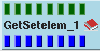
GetSetelem performs the operation of selecting an element out of a set.
The ports are "symmetric". One port (you may select the first one) allows you to perform this operation for a set of unstructured grids (or a tree-like set structure, the leaves of which are grids). The other ports have a similar functionality, but work with unstructured data (scalar or vector) objects instead of unstructured grids.
It has been tested on SGI platforms.
| Name | Type | Description |
| stepNo | Scalar | Number of the desired element in the list of elements of the incoming sets. The numbering starts with one. |
|
|
| Name | Type | Description |
| optionalinput_0...
input_7 | IntArr UniformGrid RectilinearGrid StructuredGrid UnstructuredGrid Points Lines Polygons TriangleStrips | input_mesh or data from which you wish to extract an element |
|
|
| Name | Type | Description |
| outputoutput_0...
output_7 | IntArr UniformGrid RectilinearGrid StructuredGrid UnstructuredGrid Points Lines Polygons TriangleStrips | Output grid or output data for the selected element. |
|
|
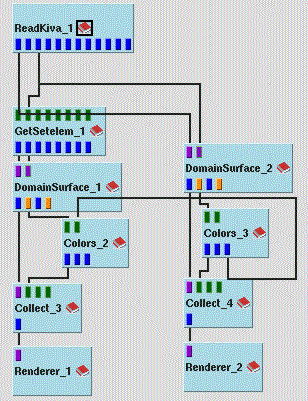
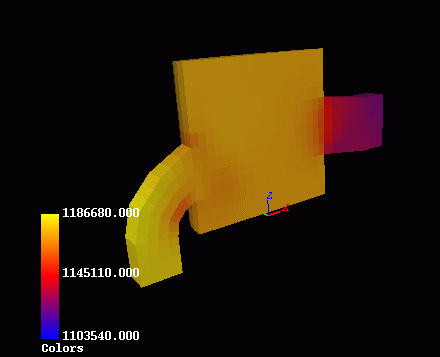
In this map ReadKiva is used to extract time step data from a fluidic simulation. Five time steps are generated, and GetSetelem is used to extract the third time step, whose output is shown below.
| Authors: Martin Aumüller, Ruth Lang, Daniela Rainer, Jürgen Schulze-Döbold, Andreas Werner, Peter Wolf, Uwe Wössner |
| Copyright © 1993-2022 HLRS, 2004-2014 RRZK, 2005-2014 Visenso |
COVISE Version 2021.12
|