| Overview | All Modules | Tutorial | User's Guide | Programming Guide |
Module category: Tools
MakeTransient generates a specified number of timesteps.
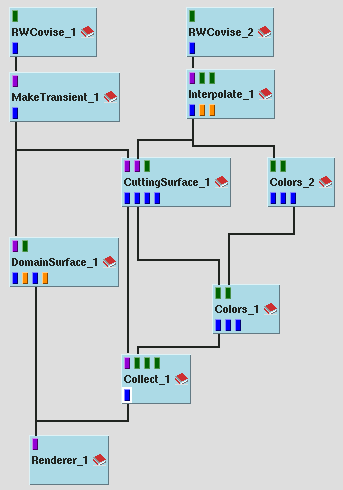
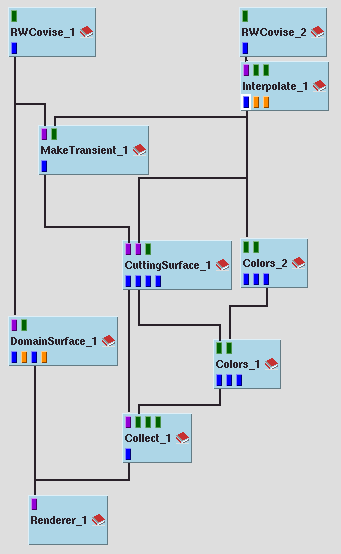
MakeTransient allows you to generate a number of timesteps (default 72) out of 'static' data. This number can be specified explicitly as parameter or it can be generated according to the second (optional) input port. Typically you use MakeTransient to replicate the geometry and Interpolate to generate the corresponding data, and you get the number of timesteps for MakeTransient from Interpolate. With a Timestep Sequencer that shows up in the Renderer you can go thru your timesteps, either step by step or using 'play'.
It's tested with Covise Release 5.2 on SGI
| Name | Type | Description |
| timesteps | scalar | number of timesteps (default 72) in static case. If the input object already is transient the time series is multiplied timesteps times. |
| Name | Type | Description |
| requiredinport | StructuredGrid Float Vec3 RectilinearGrid UniformGrid UnstructuredGrid Polygons Float Vec3 Unstructured_T3D_Data Unstructured_V3D_Normals Texture | |
| optionalaccordingTo | StructuredGrid Float Vec3 RectilinearGrid UniformGrid UnstructuredGrid Polygons Float Vec3 Unstructured_T3D_Data Unstructured_V3D_Normals Texture | number of steps according to this input |
| Name | Type | Description |
| outputoutport | see input port 1 | same as input, but 1 for each timestep |
|
|
The second example shows you, how to use the second (optional) input port of MakeTransient to get the right number of steps according to the first output port of Interpolate.
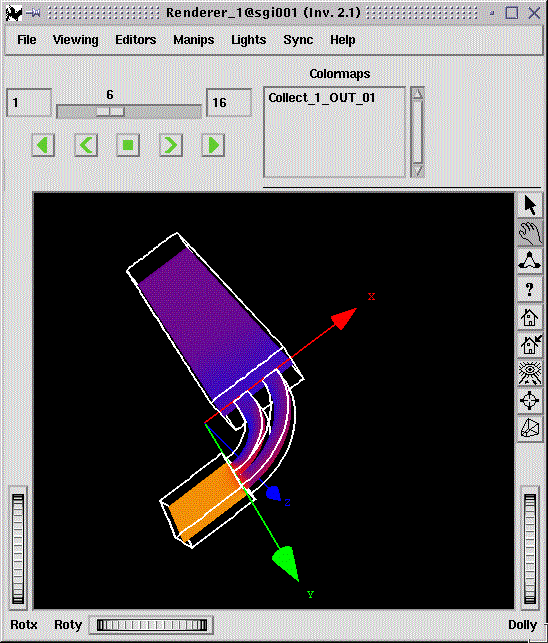
The Renderer picture contains the Timestep Sequencer generated by MakeTransient.
| Authors: Martin Aumüller, Ruth Lang, Daniela Rainer, Jürgen Schulze-Döbold, Andreas Werner, Peter Wolf, Uwe Wössner |
| Copyright © 1993-2022 HLRS, 2004-2014 RRZK, 2005-2014 Visenso |
COVISE Version 2021.12
|